North Albanian epos, or the cycle of heroes, was brought to the attention of scholars a century ago. It was made manifest precisely at the end of the epoch of National Renaissance, which has been justly called a century of the “the cult of epopee”.
Albanian literature was born and developed for a long time as the literature of heroes. Those who were not aware of the existence of the oral tradition of the epos of heroes tried to create “fictional epopees” and introduce them as oral heritage. Later on, there were attempts at recreating an integral epopee according to the pattern of poems of antiquity.Like in any other epos, in Albanian epos, too, time runs in accordance with a calendar different from the humans’ calendar, which reminds one of the mentality of “The Feats of Gilgamesh” where one day in the time of deities is as much as a thousand years in the time of humans. Mythological heroes of Albanian epos remain dead for a hundred years and upon waking they say, “I have been taking a nap”. As Muj, one of the main heros meditates, “is able to observe the grass growing”. In epos there is only a distant and undefined past. Time in the mythological imagination does not respect human time.
Two important features of the mythological northern cycle figures testify the remote ancientness of Albanian epos: their matriarchal character, on the one hand, and chthonic character, on the other hand. This is another aspect of the question of autochthony – or allochthony – of the population that has created them. In the Hellenic epos deities are matriarchal and patriarchal. They coexist and conflict, win and suffer defeat, fight for power and protect it. The cycle of Artrides ends up in the tragic dilemma of Orestes, who has to break through a tradition and establish a new one: protect the right of fatherhood against that of motherhood.
The heroes of Albanian epos are the sons of Ajkuna. Quite unlike the cycle of ballads, where “a wise old man”, advising a sacrifice of the bride over the bridge, reminds one of the patriarch, in Albanian epos there is no patriarch. For the first time, the father in the epos appears in the figure of Muj, as contrasted to Omer (or “seven Omers”). In one of the songs, Omer has to release “father and uncle” from the king’s prison. The rhapsodist entitled the song "Omer from Muj" and this is the only case where a shade of a patriarch appears. Ajkuna plays the central figure and authoritative role. Muj and Halil do not have a father in formal terms; they are sons of the same mother running the house and they take their power from the deities. After Omer, there are no more heroes. Their power and glory is not inherited.
The matriarchal feature of mythological characters of legendary epic is made more emphatic by the general feeling of the well-known rhapsody of Gjergj Elez Alia. It is commonly stated that, in this song, the earth powers are matched against the powers of the sea (“a black giant has emerged out of the sea”). Traces of Byzantine culture have been tracked and found, such as is the exacting of tribute by the giant, as the laws of the empire government demanded. In fact, the main source of Gjergj Elez Alia rhapsody is the end of the era of human (woman) sacrifice for an act, campaign or tribute. Gjergj Elez Alia rises from his deathbed to rescue an era from the morality inherited from the distant past when people could be sacrificed alive – as in the case of the walled bride in the Balkan ballads. He beats the giant, who demands “a roast ram” and “a young maiden” every night. The defeat of the giant marks the end of that convention which legitimised woman sacrifice. Gjergj Elez Alia ensures a permanent deliverance of women from sacrifice.
The chthonic (earthy) character of the deities of Albanian epos defines the autochthonous character of the people. Unlike homeric poems, where the deities have a multilevel hierarchy (underground, semi-earthy -- Persephone spends half of the year underground and the second half on heavenly – chthonic and uranic – earth), in Albanian epos this hierarchy does not exist. The mythological figures of Albanian world are earthy ones. In narrative folklore, including the epic and tales, "the seraph of heaven" does not exist. Along with the "earth nymph" (of this earth), in the ethno-folkloric tradition of the country, fairy characters emerge and merge.
The chthonic feature of Albanian mythological actors of Albanian epos corresponds to that level of thought when, in Hellenic literature of antiquity "Gods descended from the Olympus", and yet they remained important figures of the conscience of belief. This goes back to a later date than the Uranic (heavenly) layer of mythological figures, but, however, earlier than the time when Greek Gods made a laughing stock of themselves in Aristophane's comedies. The two calendars of time in the epos and history of human life are connected with the distinctions between the mythological perception of time in the ancient and modern mentalities. One of the interesting folkloric facts in this regard is the use of time for space and vice-versa, which is viewed as a universal feature of the epos. In Albanian epos, distance is usually shown by expressions such as “nine houses away” or "nine years' travel".
This resembles the literary idiom of Sumerians, where distance is not measured by units of space, but units of time: "The eagle clutched me with iron claws, / And hovered me into space for four hours”. Or, "We went whither, twice twenty hours, / Until we discerned from afar a corner of the earth”. The use of time for space and vice-versa is linked with that level of mental development of human world, where the process of movement from the past to the present was perceived as unidimensional. Time and space were unified almost indistinctively into this dimension. These mentalities of an ancient and antique stage constitute the primary artistic arguments for the debate on the origin in point of time of Albanian epos. The cycle of Albanian heroes contains an intertwining of features of antique and Medieval European eposes. But we know of a greater number of antique eposes than European Medieval European ones. There are a number of arguments in favour of a relative chronological determination of the source of epos in the period of transition from Illyrians to Albanians, from Illyrian to Albanian language, from the end of Romanticism to the confrontation with Slav invasions.
In Slav science, the northern cycle is considered as a recreation of the motifs of Serbo-Bosnian epos following a massive Islamisation of Albanians, sometime in the 18th century and on. Some of the local scholars share the opinion that Albanian epos is "of the Byzantine period" and its origin should be connected with the time of creation of "Digenis Akritas" among the Greeks. By tying its origin with the birth of the Slav or Byzantine eposes, these views, at times openly and at times implicitly, at times for certain purposes and at times owing to a lack of trust in facts, put the formation of Albanian epos at a chronologically much later date. The data concerning the overall cultural development of Albanians indicate that the northern epos was created in a period of divergent development. This is the period of the largest territorial division of Albanian ethnos (into Gheg and Tosk) – in fact there can be found no traces of the epos south of Shkumbin River. This is the period of the separation of South polyphony from the North homophony. This is the period of rhotacism in the South and nasality in the North. This is the period of the preservation of “a” in Gheg and its transformation into “ë” in Tosk. From the cultural viewpoint, epos was born when the most important two-branched changes in Albanian culture – Gheg and Tosk – occurred. This does not mean that epos is a folk tradition isolated in the North. There are abundant data proving that the northern cycle is not that northern as to be called self-segregated. Its fundamental motifs are found to have developed in the folklore of southern territories in the form of narratives, tales or legends.
From the historical perspective, epos may not arise at any time and following any event. Albanian epos itself is totally prevailed by the conflict between its carriers and the population, which had moved to the Balkans; it bears the stamp of Slav invasions. Albanian epos rules out the idea of its creation from the first contacts with the newly-settling population, drawing the attention of the audience to the fact that other things had occurred before the time "when there was an allegiance to the king”. A more tendentious research could also explore data which bear witness of a danger from the sea and which could be connected in the underground with an echo from the time of Roman conquest. Both these facts and reasoning enable one to develop the view that in epos, irrespective of its multilayered character, there exists, however, a “first time”. It coincides with the 7th and 8th centuries AD, when the most important divergent internal changes occurred in the ethnic culture, when qualitative cultural transformations occurred, such as the transition from Illyrian to Albanian, the consolidation of Gheg and Tosk koines (instead of the narrow speech of tribes). This process of divergence was progressive because, by separating the northern cultural koine from the southern one, it developed convergence within them, in the same way as the four dialects of Greek language had developed in antiquity. It was just in this period that the local population was faced with Slav invasions in the Balkans and recognised step by step their expansive character.
In addition, the data concerning the notion of a mythological space in the epos favour a connection of its origin with the period of these great transformations. If a researcher were to explore a prehistoric “habitat” of the world of epos characters and events, of a "spiritual fatherland", of a "patria poesis", this would be found in the cult of the land of forefathers, myth of native land, sanctification of highlands, deification of land, in the sense the Germans use this word when they say “land”. Though limited, certain data on the ethnically separatory character of the people have been inherited in the Albanian spiritual world. These start with the distinction “we-others”, which is one of the earliest signs of community conscience. Most likely, the “champion-enemy” position is the same as the “Hellenes-barbarians” position among old Greeks. Although one might speak of the notion of land, the native land, Albanian Ithaca, as the notion of Moré is among the Arbëresh (in their historical songs), rather than of a well-defined space, yet the conscience of a fatherland which makes carriers of the epos feel “at home” among them, is at times evident. It is worth recalling that in ancient Hellenic epos, fatherland was used in two senses: Odysseus was son of Hellas, but he finds no peace unless he reaches “the fatherland”, Ithaca.
Evidence of the presence of ancient cultures in the Albanian subject, especially of Greek-Roman culture, constitutes a testimony of its ancientness and its neighbourhood with these ancient civilisations. Lambertz argues that the northern epos comprises “over 40 topics similar” to Akritas' songs. Selection of Muj (“having both strength and power”) is like the selection of Heraclitus. In a well-known Albanian song, little Omer must release “father and uncle” from prison, in the same way as Armouropulos (little Armour) in Akritas' songs. These traces drive one to come to the conclusion that Albanian epos, called “northern cycle”, in view of its artistic connection with the entire local folklore, is not that northern and limited as denoted by the term. Even historical geography does not matter much here.
Layering epos on the basis of types of characters is especially important. Belonging to the infancy of mankind, mythological characters need more attention and depth. The main heroes of the epos (Muj) represent the cult of power, just like Achiles in Homeric poems; whereas transition to the stage of the cult of knowledge-craft (the cult of Odysseus) is not confirmed entirely. The focus of Albanian epos is the war hero, whereas the peace hero, "second hero" -- Halil -- is more inclined to the cult of beauty. In Hellenic epos, Odysseus had to subdue temptations of adventure and escape, far away from his country as he was; as such he had to resolve situations with wisdom; whereas in Albanian epos, Halil is living in his native country and has to win the hearts of "chicks" of human grace.
Author Dr. Shaban Sinani
Bibliography:
1. Albert Lord, "The Singer of Tales", 1962.
2. Maximillian Lambertz, "Die Volksepik der Albaner", Leipzig,
East Germany, 1958.
3. "Epi i Gilgameshit", 1999.
4. "Shah Name", translation of Vexhi Buhara, hand-written manuscript.
5. Çështje të Folklorit, "Albanian", 1-6.
6. Fatos Arapi, "Këngë të moçme Albanian", 1986.
7. Berndardin Palaj - Donart Kurti, "Visaret e Kombit"-2, 1937.
8. Gjergj Zheji, "Vargu i këngëve të kreshnikëve”, 1987.
9. Eqrem Çabej, “Problemi i autoktonisë së shqiptarëve në dritën e emrave të vendeve”, 1958/2.
10. Faik Konica: "Shqipëria -kopsht shkëmbor në Evropën Juglindore", 1993.
11. Stavro Skëndi, “Albanian and South Slavic Oral Poetry”, Philadelphia 1954.
12. Vladimir Propp, "Morfologija skaskih",1958.
13. Shaban Sinani, "Mitologjia në eposin e kreshnikëve", 1998.
14. “Bernardin Palaj - opere”, Roma 1969.
15. Celentano. L. “Letteratura greca”, Napoli 1995.
16. Clarotti-Crussi, “Viaggio nell’epos”, Torino 1996.
17. Robert Elsie, “Albanian Folktales and Legends”, Tiranë 1994.
18. Vladimir Propp, “Ruskij geroiçeskij epos”, M. 1958.
19. Sigmund Freud, “Psicoanalisi dell’arte e della letteratura”, Roma 1993.
***
The whole world had heard of the heroic deeds of Gjeto Basho Mujo before he had even reached the prime of his life. He had stalked hordes of wild beasts in the mountains and slain many an enemy from the Kingdom of the Christians and from beyond the sea. Mujo defended the country and the poor people. His heroic deeds and his courage were famous throughout the Krahina and especially in Jutbina. No foreigners dared cross the border of the Krahina to plunder and maraud. Together with his band of thirty warriors, Mujo had conducted many raids in the Krahina and the Kingdom of the Christians, penetrating right to New Kotor and even farther, and every time he returned home victorious. Such a man was Gjeto Basho Mujo.
The days, months and years passed until, as is the custom, the time came for him to marry. One day, therefore, Mujo mounted his steed as the first rays of dawn struck the peaks, and crossed the mountain passes into the Kingdom of the Christians in order to find himself a bride. He chose a fair maiden from a good family whom his friends had recommended and who was fitting for Mujo’s lineage.
As soon as Mujo had arranged for his marriage, he returned to Jutbina and assembled three hundred attendants to collect the bride, all of whom were his friends. The three hundred shone in their robes of sparkling gold and bore golden swords, arrows and lances. All of them rode white steeds with saddles of gold. All were young with the exception of their leader, an old man with grey hair called Aga Dizdar Osman who was second in command only to Gjeto Basho Mujo.
Before the attendants set off to claim the bride in the Kingdom of the Christians, Mujo spoke to them, saying, “Listen to my words, attendants! When you reach the mountain pastures, you will come across three shady resting spots. Take care not to revel and not to dismount for a rest. Be careful not to drink from the springs there for it is inhabited by three evil Zanas. They may be having their afternoon nap there or refreshing themselves at the water and you may disturb and upset them. They never let anyone escape unharmed.” Mujo warned the attendants strictly and they promised to follow his instructions.
The next morning, the attendants saddled and mounted their horses and set off in what was a joyful spectacle for all of Jutbina. They departed for the Kingdom of the Christians to pick up Mujo’s bride, singing songs and playing music with their horns. When they reached the mountain pastures, they remembered Mujo’s warning, stopped chanting and making music, dismounted and led their horses by the reins in silence. Nowhere did they pause, nowhere did they drink from the springs, nowhere did they rest in the shade, nowhere did they stop to dance and make merry. They carried on over the mountains and arrived safe and sound on the other side at the bride’s home in the Kingdom of the Christians.
Her father welcomed the attendants, giving them food and drink and entertaining them with games and amusements. The music and dancing echoed until midnight. When the stars faded and the next day dawned, the attendants rose, girded their weapons, collected the bride and set off for Jutbina. They continued singing and revelling on their way. The peaks and valleys echoed their mirth.
And so they arrived at one of the three resting spots. Here they remembered Mujo’s words, stopped singing and revelling and carried on in silence. But then Aga Dizdar Osman, the old man with grey hair, spoke, “Listen, attendants of the bride. I have accompanied many a bride. We have always stopped and revelled at this resting spot and quenched our thirst at this spring. We have always dismounted to dance. Nothing has ever happened to us here. So let us make merry!” When the other attendants heard this, they stopped at the resting spot right away, dismounted and began to sing and dance. They muddied the springs and streams, set up targets and shot at them with their bows and arrows. The mountain pastures echoed with their mirth once again.
Suddenly there was a terrifying clap of thunder. The din resounded through the mountains, a strong gale began to blow through the trees, the mountain pastures thundered and quaked. Hovering over the peaks in the midst of the storm were the three evil Zanas. They gnashed their teeth, spewed smoke and fire and descended upon the resting spot where the attendants of the bride had chosen to stop. In the blink of an eye, the three Zanas turned the attendants to stone and transformed their horses into tree trunks. Where but a moment ago song and merriment had resounded, no human voice or neighing of horses was to be heard. Silence and death reigned. The mountain peaks echoed no more, the wind ceased to blow, the resting spots, the meadows and springs were emptied. Left all alone in her horror and shock was Mujo’s bride. She alone had survived, but did not know what to do or where to go. The Zanas lunged forth to attack her, seized her by the arm and dragged her off into a cavern deep in the mountains where no human being had ever set foot. There they kept the maiden prisoner, forcing her to feed them and bring them water so that she never had a moment’s rest.
Gjeto Basho Mujo knew nothing of what had happened. He waited for the attendants to bring him his bride. He waited and waited but they did not come. The longer they were away, the more Mujo began to worry. He listened for singing or for the neighing of horses, but there was nothing to be heard. Finally he realized what had happened. The attendants of the bride had broken their word. He was in despair for he knew that the three Zanas were evil to the core and had unimaginable skills.
He waited no longer. Heaving a sack filled with bread and meat over his shoulder, he mounted his steed and set off for the mountain pastures. ‘What can all the warriors possibly be doing in their garments of gold and with their golden swords, arrows and lances?’ he wondered. ‘What has happened to the horses that speed like the wind?’ He looked everywhere but could see nothing but stones and tree trunks. Mujo approached the stones and recognized their form as that of his warriors. Yes, the white stone was their leader, Aga Dizdar Osman; the reddish one was like Ali Bajraktar and the next was like Butali Tali. One by one, he recognized them all: Basho Jona, Zukut Bajraktar, Shaban Evimadhi, Kazi Mehmet Aga and the rest. Once beings of flesh and blood, they were now turned to stone. But nowhere could Mujo find his bride. He was in such despair that he almost broke into tears!
But Mujo was a man of courage. He concentrated his thoughts on how to turn the stones and tree trunks into living beings again. He did not restrain his horse or dismount but rode back and forth over the desolate mountain pastures looking for the spring of the Zanas, for their resting spots, and for his bride. He entered a dark grove of beech trees, riding deeper and deeper to where the sun’s rays no longer penetrated. He continued on his way until he came to a spring with water as sparkling as tears. There he stopped and dismounted to rest for a while. He took a good look at the beech trees but could find no path through them, only bushes and scrub. Rising above the grove was a cliff covered in grass. At the foot of it he saw a number of boulders buried in scree. The branches of the ancient trees were so entwined with one another that no sunlight or wind could get through. Eternal twilight reigned here.
“This must be the home of the Zanas,” Mujo thought to himself. He put his horse to pasture among the beech trees and sat down beside the spring, waiting patiently for the Zanas to arrive. Three days passed and no one came. Mujo saw deer approach the watering hole but he did not string his bow. He saw fair feathered birds but he did not shoot at them. He had not come to hunt but for something more important. When three days had passed, he caught sight in the twilight of a young maiden in her bridal gown bearing a water jug in her hands. She was as fair as the moon in May, but so sorrowful. Mujo wondered what the young maiden was doing in such a dark and gloomy place. Perhaps she was a vision. But no, she came closer and closer. Suddenly Mujo recognized her and his heart began to beat rapidly. The maiden with the jug arrived at the spring, saw Mujo but did not recognize him. “Good day, young man!” she said. “Good day, young maid,” he replied. She put her jug down to fill it. “Whom are you fetching the water for, maid? Whom are you taking it to?” “Oh, do not ask me, young man. I am of a noble family and have just been married. My attendants were taking me to my husband when…” The maiden proceeded to tell him the whole story of how the Zanas had petrified the men and horses and of how she had been taken prisoner.
Mujo asked her, “Who were you marrying, maid? What was the man’s name?” “Oh, wretch that I am, I left my mother and father, I left my brothers and sisters to marry a famous warrior. His name is Gjeto Basho Mujo. Do you know him, young man? Have you ever heard of him, Gjeto Basho Mujo of Jutbina? Mujo neither laughed nor responded. He stared at the fair maiden and said, “Do you recognize me, fair maid?” “How could I possibly know you. I’ve never seen you before. But when I look at you, I am reminded of what I heard of Mujo. You could be Gjeto Basho Mujo.”
Mujo could wait no longer and laughed out loud, “I am Mujo, fair maid! You have recognized me indeed. But if you are the daughter of a noble family, will you now listen to me and to what I have to say?” “I give you my word,” she replied, “by the ruler over the sun and the moon, over heaven and earth, that I will listen to what you have to say, Mujo. I would have faith in you even if I knew you were going to behead me.” “No, I would never behead you, for I loved you and still do. I am going to try and save you and bring your attendants back to life. To do this, however, I must know the source of the Zanas’ power. Therefore, when you return to the cavern, say to them that you know they are very powerful and ask them where they get their power.” “Do you really think that the Zanas will tell me the source of their power, Mujo?” “Do not lose heart, maiden. Do as I tell you. The sun is now setting behind the mountains and the moon is rising over the beech trees. The Zanas will soon come to the spring to dine in the moonlight. When they sit down to dinner, stand at a distance and do not eat or drink anything. The Zanas will take pity on you and will not want to eat without you. Then, if you remember what to say, they will divulge their secret. Say to them, ‘Mountain Zanas, may you always have bread to eat, may you always have the high mountains to live in, may you always have resting spots for your afternoon naps and springs to refresh yourselves in. I have been living with you for some time now and will live with you forever as your prisoner. Why don’t you tell me where your power comes from?’ Ask them, for there is no reason why they should not believe you. And even if they should turn you to stone, I shall do everything in my power and save you. I will wait for you here tomorrow.” “All right, Mujo. I will do as you say.” The maiden picked up her water jug, said good bye to Mujo and disappeared into the darkness. Mujo watched her as long as he could and then returned to the Green Valleys.
The maiden went back to the cavern. The Zanas asked her, “Why are you so late, dear bride?” “The water was muddy, dear Zanas, and I had to wait for it to clear.” “You have done well, my dear.” The sun set and the moon rose, shining over the tips of the beech trees and spreading its rays into the valleys and gorges. There was a light breeze which caused the leaves to rustle. The birds twittered among the branches. The deer came out of the forest to graze and drink. The mountain Zanas waited no longer. They went off to the spring and set the table to have dinner. The young bride stood near by, broke the bread for them and brought them their water, but did not sit down with them to eat. She stood there, her eyes downcast. The youngest of the Zanas asked her, “What is wrong, dear bride? Why are you not eating or drinking? You are not ill, are you? Or are you homesick for your fellow human beings?” “No,” replied the maiden, “I am neither ill nor homesick. I am content to be here where I am. You love me. That is why you wanted to keep me with you. If you did not love me you would have turned me to stone as you did the others, but I simply cannot eat or drink anymore until you answer a question I have to ask you. Therefore I swear in your presence, dear mountain Zanas, may you always have bread to eat, may you always have the high mountains to live in, may you always have resting spots for your afternoon naps and springs to refresh yourselves in, may you always have the light of the moon to dance by… Why don’t you tell me where your power comes from? You have become my sisters. I will always be with you. I can find no better place to live than here with you because nowhere on earth could I find more kind and understanding sisters.”
The moment the two elder Zanas heard this they leapt to their feet to turn the poor maiden to stone, but in a flash the youngest Zana intervened, stretched out her hands and covered their mouths so that they could not pronounce the fatal words. She called out, “May God damn you, sisters. What could this young bride possibly do to us if we told her of our power? She is a human, we are Zanas. She is of the earth, we are of the heavens and earth. She is our prisoner, we are the rulers. She has given us her word of honour and we must not doubt it. She breaks our bread for us and brings us our water. We must tell her the truth.”
The elder Zanas stepped back. The youngest one turned to the bride and said, “Listen, daughter of man, we have three wild goats with golden horns grazing in the Green Valleys. No one on earth can capture these goats because they are so light footed and can jump from rock to rock and leap from cliff to cliff. Even the bears and wolves fear them because they attack with their golden horns. But if someone were to capture them I shudder at the thought we would have no more power. We would no longer be able to fly and turn humans to stone. We would be women like all the others.” When the bride heard this, she smiled, sat down and ate dinner with them as usual.
When the three Zanas had finished their meal, they refreshed themselves in the spring, picked flowers and made wreathes of them which they placed on their heads. Then they sang and danced. The moon and the stars looked down upon them from above. Mujo’s bride watched them from below. The oaks and beeches made no sound. When the three Zanas had finished singing and dancing they joined hands and returned quickly to their cavern. Silence reigned.
When the new day dawned and the Zanas were still asleep, Mujo’s bride rose, took her water jug and went to the spring. There she found Mujo waiting for her. He was delighted to see her. “You have survived, I see.” “Yes, I was almost turned to stone. But ask no more questions. I know you are brave, but they are mountain Zanas and have tremendous power.” “And where do they get their power?” Mujo asked. The maiden then told him about the three wild goats with the golden horns. Mujo listened attentively and said, “I understand, maiden. Now it is my turn. Go back to the Zanas, wait there and do not be afraid. Simply pretend you know nothing. I will return to fetch you safe and sound. I will also bring your attendants back to life and then we will hold our wedding a second time with an even bigger celebration so that the very mountain pastures will resound with the merriment. The Zanas themselves will be your bridesmaids and accompany you in a golden carriage right to my fortress.” The maiden looked bewildered and, though she was not too sure, she believed him. She had to smile, however, at the thought of the Zanas with her in the bridal carriage.
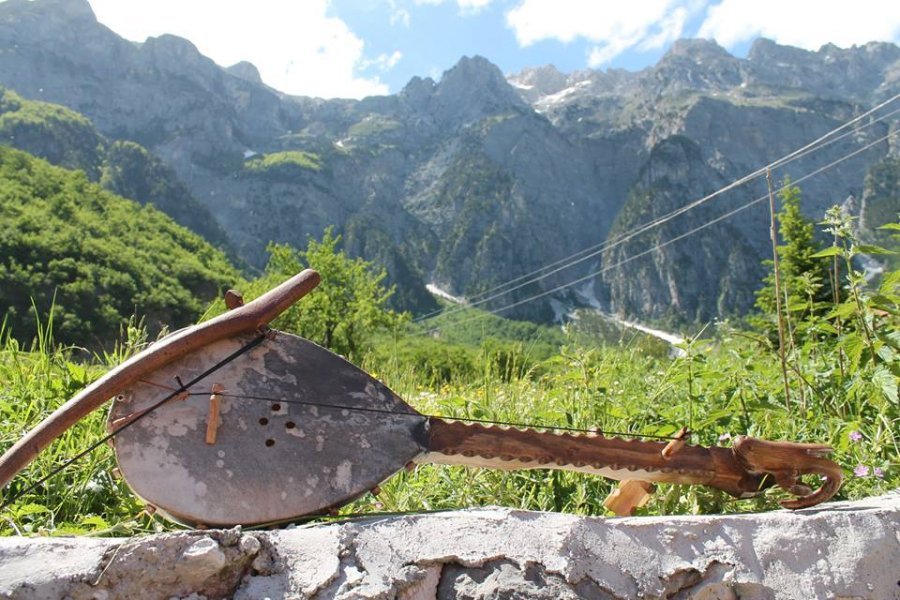
Mujo waited no longer. He said farewell, mounted his steed and rode off to Jutbina. He stood in the middle of the square and shouted at the top of his voice so that all of the Krahina could hear him, “Listen to me, men! Gjeto Basho Mujo is speaking to you. Let all brave hunters come to my fortress tonight with their hounds. I will give you as much to eat and drink as your hearts desire, and tomorrow we will set off for the hunt. Do you hear me?” Then he returned home, slaughtered sheep and lambs, had bread baked and the ovens heated. As soon as they heard Mujo’s call, three hundred brave hunters gathered with over a thousand hounds and marched towards Mujo’s fortress. “You called, Mujo?” “Yes, my brothers, I called you. Come in!” Mujo received them cordially and invited them to dinner. He asked Halil to take out his lahuta and play for their entertainment.
At the break of dawn, Mujo said to his friends, “Listen, hunters, to why I have called you. There are three wild goats with golden horns grazing in the Green Valleys. I want to take these three goats alive. We will therefore encircle the mountain pastures and hunt them until they tire and fall into our hands. But take care to use neither arrow nor lance, for if you wound or kill them, none of you will ever return to Jutbina alive.” “We shall do as you order, Mujo,” replied the hunters.
Mujo then led them into the Green Valleys. There they encircled the mountain pastures and took up their positions. There was no room for even a bird to escape. Mujo entered the circle with a few light footed friends and some of the hounds. The others lay in wait. Then, sounding their horns unceasingly, the hunters pursued the goats from rock to rock and from cliff to cliff. The very mountain pastures trembled. When three days and three nights had passed, the goats grew tired, fell to the ground and lay their heads on the earth to rest. Mujo thus captured them alive, took them back to Jutbina and locked them up in a pen, bringing them fresh grass and water from the mountain pastures. He invited the hunters to dine with him once more, gave them presents and bid them farewell.
And what happened up on the mountain pastures? The mountain Zanas suddenly lost their power. They tried to fly but they could not. Their bodies had become stiff and heavy. They ordered the wind to blow through the beech trees, but it refused. They concentrated their thoughts on the wild goats, but the goats did not come. The Zanas then set off to look for the goats; they searched the valleys and the cliffs, but the goats were nowhere to be seen. The eldest Zana clapped her hands and said, “Zanas, my dear Zanas of the mountain cliffs, someone has captured our goats!” Mujo’s bride smiled. “Listen to me, Zanas, I have something to tell you. Gjeto Basho Mujo send his greetings and tells you that since you stole his bride and turned his attendants and their horses to stone, he has captured your goats and is holding them hostage.”
When the Zanas heard this, they tried to turn the bride to stone, but they could not for their power had dissipated. They then set off for Jutbina, though not in flight, but on foot like human beings. Their feet were battered by the stones and roots of trees on the way. Thorns scratched their hands. And so they arrived at Mujo’s door. “Mujo, have you taken our goats prisoner?” “Yes, I have captured them and locked them up in my pen. They receive fresh grass and spring water.” With tears in her eyes, the eldest Zana then begged him, “We are in your hands, Gjeto Basho Mujo. Either kill us here at your house or give us back what is ours. Otherwise we must perish. We will throw ourselves from a mountain peak. But we are willing to give you back the attendants the way they were. We will return their horses and bring them to you. We will even bring your bride to your door in a golden carriage. You will have them all as they were before.”
Mujo answered calmly, “I do not want the attendants. I am not even interested in the bride. Leave them where they are, the attendants as stones and the bride in slavery. I can find a new wife in the Krahina or in the Kingdom of the Christians whenever I want. But I cannot let the three goats go for I have never caught anything like them before, although I have combed the mountain pastures many a time. When I remarry I will slaughter them and feed them to the guests. I will hang their golden horns on the wall to shine for me day and night.”
When the three Zanas heard this they broke into tears, moaning and groaning so that the very rocks and trees took pity on them as if they had been women, not Zanas. But Mujo was not to be moved. The youngest Zana advanced, wiped the tears from her eyes with her hair, clutched Mujo’s hand and swore, “Listen Gjeto Basho Mujo, whenever you arrange for a marriage and have a bride to accompany over the mountain pastures, whenever you have a Baloz to kill, whenever you go hunting, whenever you need a place to rest and refresh yourself, come to our meadows, take your rest, refresh yourself or do battle. We give you our word of honour that we will do no harm to anyone, that we will say nothing harmful to anyone.”
Mujo hesitated. He reflected a moment and then said, “You are Zanas and Zanas you must remain! A word of honour is a word of honour and a promise is a promise. I shall give you back your wild goats.” He then turned and called to Halil, “Halil, release the goats from the pen!” The moment the goats were out of the pen, the Zana’s faces changed and they regained their vigour. They transformed themselves into light and flew off to the mountain pastures, leaving the Green Valleys behind them.
There they returned to the attendants of stone and their horses and brought them back to life as they had promised, saying, “Arise and depart! We wish you a safe journey. Return to Jutbina where Gjeto Basho Mujo awaits you!” The attendants rubbed their eyes and said, “Oh, look how long we have been sleeping!” They did not remember having been turned to stone. They went to the spring, washed, refreshed themselves and mounted their steeds.
In the meantime, the Zanas had placed Mujo’s bride in a golden carriage and taken her back to Mujo in Jutbina. When the attendants descended into the valley on their way to Jutbina, they began to sing and dance. Mujo and Halil went out to welcome them. The mountain pastures echoed with the song of the Zanas:
“Zanas we are and Zanas we remain,
A word of honour is a word of honour,
And a promise is a promise.”
The song of the good Zanas resounded from cliff to cliff in the mountains as a second and even bigger wedding was celebrated in Jutbina. (Posted bt Bilerberg: http://united-albania.blogspot.com)




.png)